 co-life
Two solid findings point in opposite directions.
The only randomised trial ever run on this question followed engaged and newly married couples through their first two years and found that the ones assigned to merge into a joint account held on to their relationship quality. The couples who kept their money separate declined the way newlyweds normally decline. Meanwhile, couples have been walking away from joint accounts anyway. Bankrate's December 2025 survey of 1,208 people in committed relationships found 62% keep at least some money in their own name, and among Gen Z, 51% keep everything separate.
So the evidence says pool, and the behaviour says don't.
Both are right, and the reason they're compatible is the useful part of this whole topic. The trial wasn't really measuring a bank product. It was measuring what the account did to a couple's habits, and you can get most of that without ever visiting a bank.
This guide covers the decision first, then the setup, then the thing every bank's own page on this subject leaves out: what happens to the shared spending that never goes anywhere near the joint account.
Should couples have a joint bank account?
Open one if most of your costs are shared and repeating: rent or mortgage, utilities, groceries, childcare. Keep money separate if your incomes are far apart, if one of you carries debt the other didn't agree to, or if the relationship is young. Most couples end up between the two, with a shared pot for bills and personal money outside it.
That middle option is now the most common arrangement, and it isn't a compromise or a hedge. It's the structure that survives contact with real life, because it answers two different questions at once. Bills need a single predictable source. Personal spending needs to stay personal, or every haircut becomes a negotiation.
What the research actually found
The study is Common Cents: Bank Account Structure and Couples' Relationship Dynamics, by Jenny Olson, Scott Rick, Deborah Small and Eli Finkel, published in the Journal of Consumer Research in December 2023. It's a six-wave longitudinal experiment: couples were randomly assigned to a joint account, to separate accounts, or to no intervention at all, then tracked over two years.
Random assignment is what makes it worth citing. Every other study on this subject has the same hole in it, which is that happy couples might simply be more willing to pool in the first place. This one assigned the accounts, so the causation runs the right way.
The authors identify three routes from the account to the outcome: partners felt better about how they were handling money, they lined up more closely on financial goals, and they shifted toward what the paper calls communal norms. That third one is worth sitting with. The paper describes it as mutual responsiveness without keeping score.
Notice that none of the three is "the bank held the money in one place." The account was the instrument. Interdependence was the mechanism. Read that way, the finding is less "go and open a joint account" and more "arrangements that stop you keeping score are good for you, and a joint account is one blunt way to build one."
The caveats are real, and the paper doesn't hide them. The couples were newlyweds, mostly in the US, at a stage of life where merging is expected. Nothing here tells you what to do at year fourteen, or in a second marriage with children from a first, or when one partner earns four times the other.
The three structures, and who each one suits
| Structure | Works when | Breaks when |
|---|---|---|
| Everything joint | Incomes are similar, the relationship is long and legally formalised, and you already talk about money easily | One person's spending habits differ sharply, or one of you needs privacy for reasons that are nobody's business |
| Everything separate | Incomes are far apart, one partner has debt or dependants from before, or you're early on and testing | The shared costs quietly land on one person, month after month, and nobody notices for a year |
| Joint for bills, separate for the rest | Almost always | Nobody agreed what counts as a bill, so the boundary gets renegotiated at the till |
The third row has a variant worth naming, because it fixes the most common objection to it. Instead of both partners paying the same amount into the joint account, each pays the same share of their income. Someone on 2,000 a month and someone on 4,000 pay in a third of their income each rather than an identical 800, and the shared pot fills the same way. We wrote up the arithmetic in how to split household expenses fairly, and the same logic applied to the biggest single line is in how to split rent fairly.
How to set up a joint account without merging your whole life
- Write down what the account is for. An actual list: rent, utilities, groceries, insurance, the child's swimming lessons. What goes wrong without it: one of you thinks a shared holiday is obviously a joint cost and the other thinks it obviously isn't, and you find out in an argument rather than in advance.
- Decide how it gets funded, equally or proportionally. Pick one and say the number out loud. What goes wrong: "we'll just both put in what we can" holds for about five months.
- Automate the transfer for the day after payday. Standing order, both sides, same date. What goes wrong: a manual transfer becomes a monthly favour, and favours get remembered.
- Keep personal money outside it. The whole point of the hybrid is that some spending needs no explanation. What goes wrong: if everything runs through the joint account, you've built the fully-merged version by accident and inherited its privacy problem.
- Agree a number above which you check first. Two hundred, five hundred, whatever fits your life. What goes wrong: without a number, either every purchase feels like it needs permission or none do.
- Say what happens if one income stops. Redundancy, illness, parental leave. What goes wrong: you renegotiate the funding split during the worst month you've had in years.
Step six is the one couples skip, and it's the one the research is quietly about. A couple who has already agreed what happens when one salary disappears has built the communal norm the trial was measuring. The account is just where it gets stored.
The leak: shared spending that never touches the joint account
Here's the gap in every bank's guide to this topic, and it's a big one.
A joint account can only show you what passed through it. Shared costs constantly don't. The school trip you paid on your card because the form was due that morning. The vet. Your partner's mother's birthday present, bought by you, from your account. The taxi home when the last bus had gone. The plumber who only took cash.
None of that reaches the joint account, so none of it appears in the shared picture. And it isn't a rounding error. In most households the joint account covers the large, boring, automated costs, while the messy human ones get paid by whoever happened to be holding a phone. Those are exactly the costs people remember, because they're the ones that felt like a favour at the time.
This is where a joint account stops being a solution and starts being a partial one. The bills were never the problem. Direct debits don't cause arguments. The problem is the shared spending nobody logged, and no account structure fixes that, because the money left from two different places.
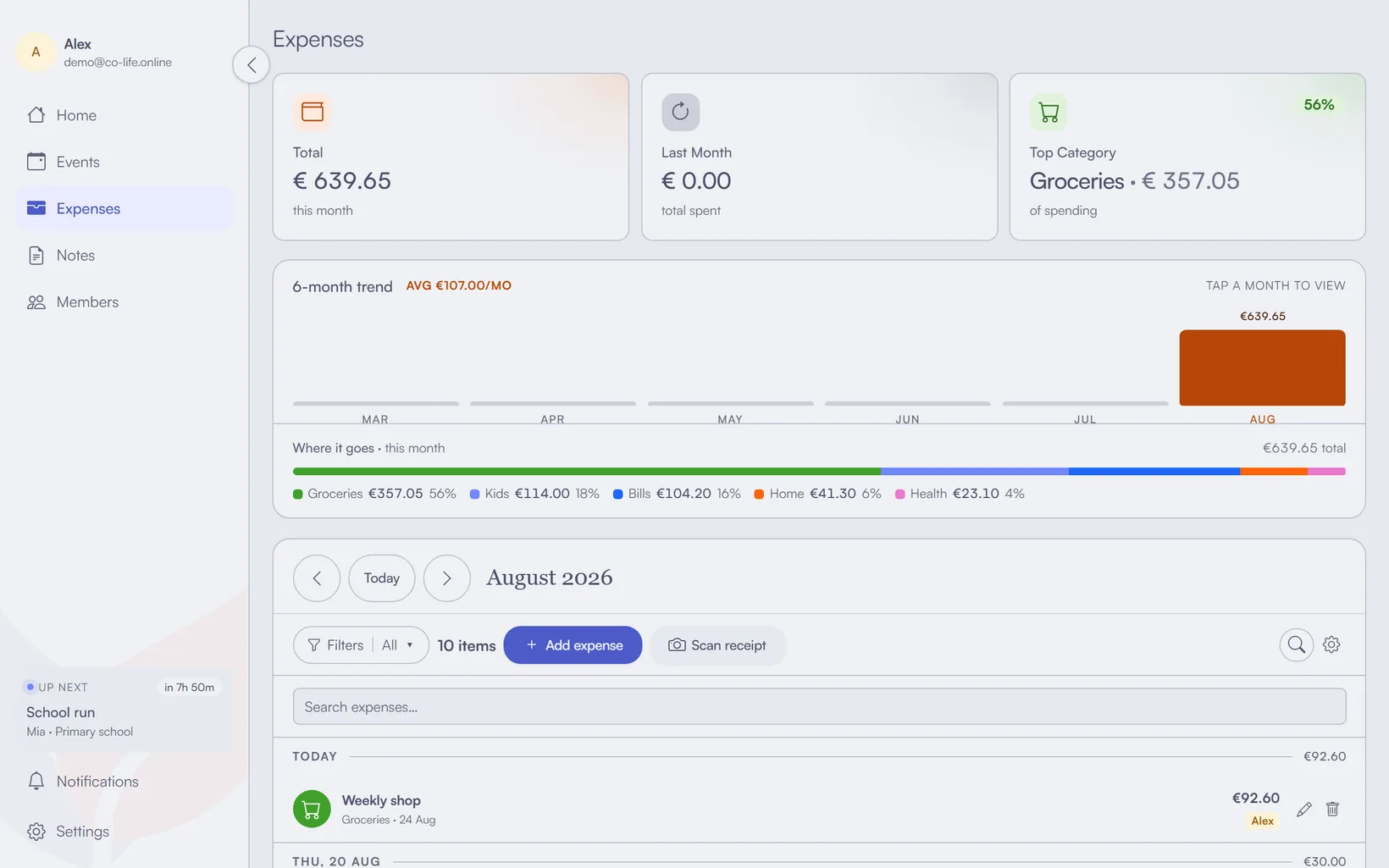
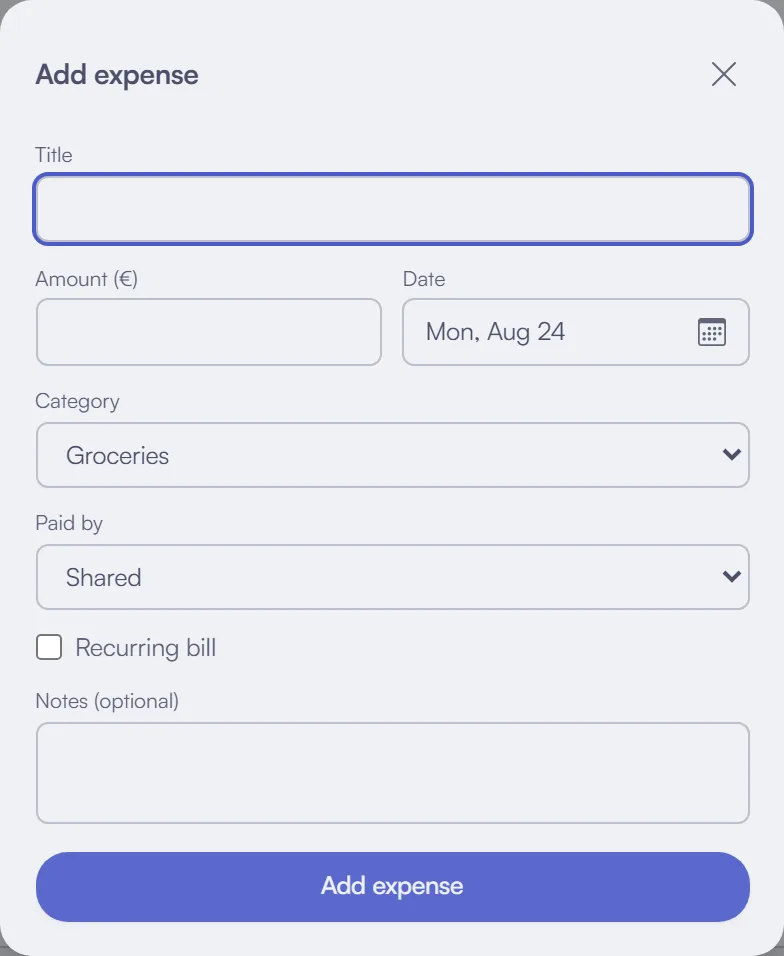
What does fix it is making the spending visible wherever it came from. That's what co-life does with expenses: every shared cost gets tagged with who paid it, whether it came off the joint card or your own. Anything paid from the shared pot is tagged Shared and shows up as the household's, not as one person's contribution.
Once a month is tagged, the Expenses screen shows what each person actually put in, alongside the household total and where it went by category. Two people who both feel like they've been carrying it can look at the same screen and find out.
Two limits, stated plainly, because a guide that oversells this is worse than useless. co-life doesn't connect to your bank. There's no open-banking feed pulling transactions in; you add expenses yourself, or photograph a receipt and let it fill in the fields. And there's no per-person balance and no settle-up. You can see what each person contributed. You won't see "Sam owes Alex 43.50," because we decided not to build that. A debt figure between two people who live together is an obligation, and obligation is the thing the research says to design out. Mutual responsiveness without keeping score, as the paper puts it. If you want a ledger that tracks who owes whom to the cent, Splitwise and Tricount do it well and you should use one of them instead.
More on running the tracking side without a shared account at all: how to track shared expenses without a spreadsheet.
Who shouldn't open a joint account
Bank pages tend to list "shared liability" as a bullet and move on. It deserves more than that.
Both names on the account means both people own all of it and both are liable for all of it. Either of you can empty it without asking. If one of you overdraws it, the bank can pursue the other. "If you're combining finances, you're not just commingling your assets," as Rayna McClane of Rebellious Resources put it in Bankrate's survey write-up. "You're also commingling your liabilities."
Concretely, hold off if:
- One partner has significant debt or a poor credit history. In some countries a joint account creates a financial association that shows on both credit files.
- You're not married or in a registered partnership and one of you contributes far more. Cohabiting couples have much weaker protection than married ones in most jurisdictions, and a joint account is not a substitute for an agreement. Worth reading alongside the moving in together checklist.
- Money is already a control point in the relationship. If one partner monitors the other's spending, restricts access to funds, or needs purchases justified, a joint account hands them a better tool. That is a well-documented pattern of coercive control, and no financial structure fixes it. Keep an account in your own name that only you can see.
Do you actually need one?
Often, no.
A joint account is the traditional answer to a question that's really about visibility and predictability: are the bills covered, and are we both carrying our share? Those are answerable without merging anything. Two standing orders into one bills-only account gets you most of it. So does keeping separate accounts and tracking the shared spending somewhere both of you can see.
If you and your partner bank in the same country with the same app, shared pots in something like Monzo or Revolut give you a joint pot without a full joint account, which is a genuinely good middle step. If your shared costs are occasional rather than structural, a splitting app is a better fit than a bank account. And if what you actually want is for the household to run without either of you holding the whole mental load, the account is a small piece of a larger problem we wrote about in how two working people run a household.
What the evidence supports isn't the product. It's the posture: pool what's shared, agree the rules before you need them, and build something that removes the need to keep score rather than something that keeps score more accurately.
The account is optional. The visibility isn't.
Start with the list from step one. Write down every cost you'd both call shared, and add up a normal month. Most couples find the number is larger than either of them guessed, and that conversation is worth more than the account it leads to.
If you want the shared side visible without merging your banking, co-life keeps a household's expenses, calendar and notes in one place, with every expense tagged to whoever paid it.