 co-life
When both partners work, the hard part of running a household isn't the chores — it's the remembering. Who booked the dentist, whose turn is the car service, did anyone pay the electricity, are we both free Thursday. Most advice on how to organize a household when both partners work answers this with better systems: chore charts, colour-coded rotas, a shared to-do app with reminders on top of reminders. But those optimise the decisions. The thing that actually wears two busy people down is making the decisions — over and over, out loud, every day.
So this guide argues the opposite of the usual productivity take: don't get better at the negotiations. Have fewer of them.
The real problem is invisible work, not chores
Vacuuming is visible. Remembering that the vacuum bags are running low, adding them to the list, and noticing nobody's booked the boiler service — that's invisible. It's the tracking, remembering, and reminding that sits behind the tasks, and in most households one person quietly carries most of it. That's the load that builds resentment, not the actual half-hour of cleaning.
You can't fix invisible work by scheduling it harder. You fix it by making it visible — moving the remembering out of one person's head and into a place you both see. Once the boiler service is on a shared calendar, it isn't anyone's job to remember it; it just shows up.
What is the mental load, exactly?
It has a name and a literature, which is worth knowing before you try to fix it.
Sociologist Arlie Russell Hochschild described the pattern in The Second Shift in 1989: as women entered paid work, they kept most of the housework and childcare on top of it — a second shift after the first one. The phrase mental load narrows that to the part nobody sees: not the vacuuming but the noticing that it needs doing, holding the list, and remembering to remind.
One correction worth making, because it is everywhere: this is often called emotional labour, and that is not quite what the term means. Hochschild coined it in 1983 for managing your feelings as part of a paid job — a flight attendant staying warm through a bad shift. She has since pushed back on the concept creeping outward to cover all domestic work. Cognitive labour is the more precise phrase for what a household actually argues about.
The distinction matters practically, not just pedantically. If the problem were feelings, the fix would be appreciation. It isn't — the problem is that one person is holding a list, and lists can be moved out of a head and onto a surface both people can see.
What about Fair Play?
If you have looked into this at all you have met Eve Rodsky's Fair Play (2019), which is the most-cited system in this space and deserves engaging with rather than ignoring.
It works as a deck of 100 cards, one per household task, grouped into categories. The insight that makes it good is the rule attached to each card: whoever holds it owns conceiving, planning and executing — noticing the thing is needed, working out how, and doing it. That single rule is what stops "I'll help if you tell me what to do", which is delegation dressed up as sharing and leaves the list exactly where it was.
Rodsky is right about the diagnosis, and the CPE rule is the sharpest statement of it anyone has written. Where this guide differs is what follows from it. Fair Play resolves the load by assigning ownership — dealing the cards well. The argument here is that a good deal still leaves you re-dealing: every card is a standing decision about whose it is, and a household with two jobs in it renegotiates constantly.
So: keep the CPE rule, which is genuinely useful. Then reduce the number of cards that need holding at all, by making the noticing part something a shared surface does instead of a person. A recurring bill that enters itself is a card nobody has to hold.
Fewer decisions beats better decisions
Here's the shift. Every recurring negotiation — "how do we split this?", "whose week is it?", "did you pay that back?" — is a decision you're paying for on repeat. Decide it once, make the answer visible, and you stop paying. That's not laziness; it's removing friction from the parts of home life that don't deserve a daily meeting.
Three shared surfaces cover most of it:
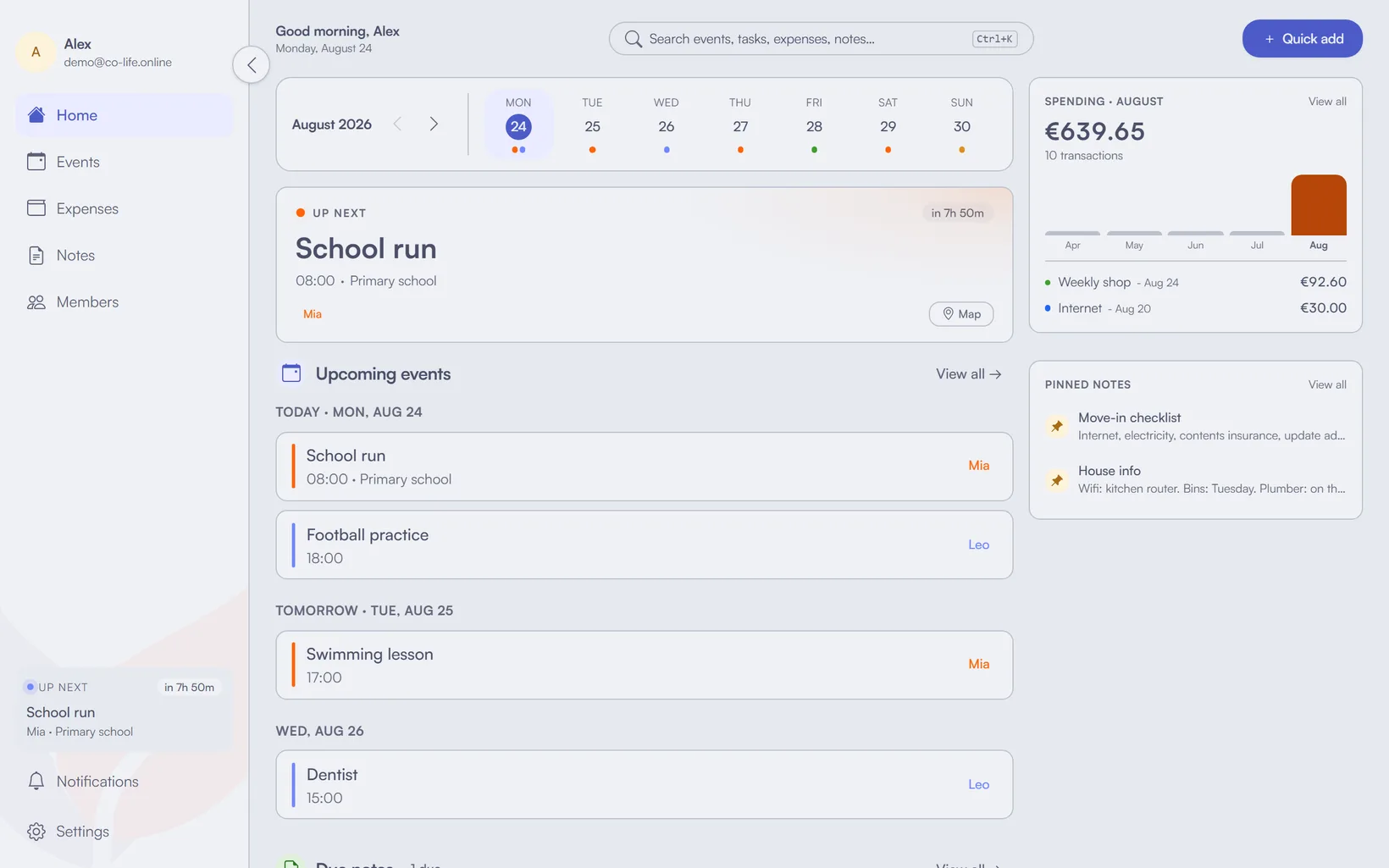
- One calendar, a colour per person. Both of your commitments in one place means "are we free Thursday" is something you see, not something you coordinate. No more accidental double-booking, no more "you never told me." The mechanics are in how to share one calendar without double-booking.
- One set of shared expenses, split a way you agreed once. Decide how you split — evenly, by income, by category — a single time, then let a shared, tagged record of who paid carry it. No monthly reconstruction from memory, no scorekeeping. See splitting household expenses fairly and tracking them without a spreadsheet.
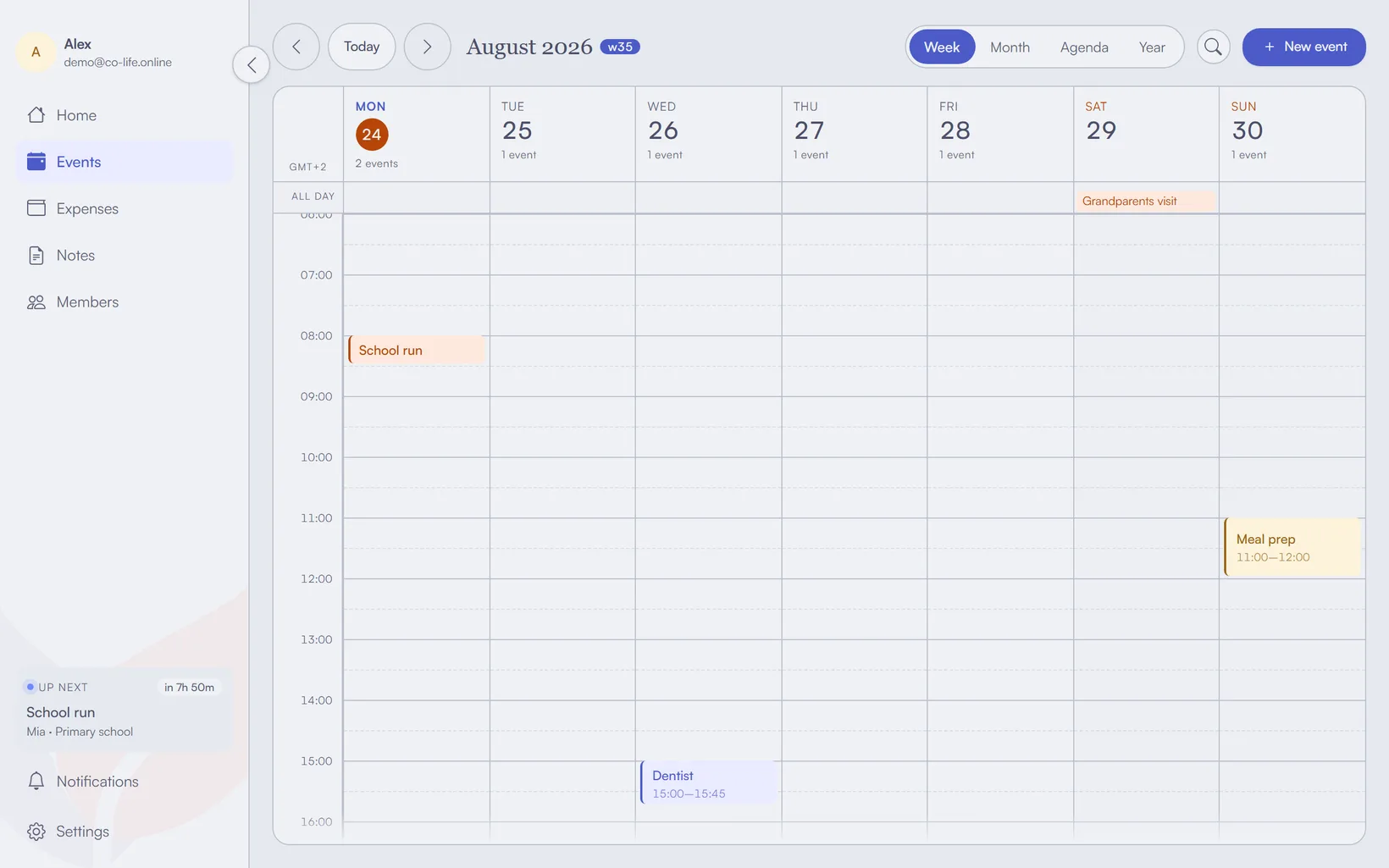
- Shared notes for the stuff that lives in one head. The plumber's number, the school forms, the "we're low on X" list. Written down and shared, it's not a thing you have to be the person who remembers.
How to set it up in an evening
You don't need a system overhaul — an hour, once:
- Put both people's fixed commitments in one calendar. Work patterns, standing appointments, the gym. Give each person a colour so a glance tells you who's busy.
- Enter the recurring bills once. Rent, utilities, subscriptions as recurring expenses — the monthly admin that runs itself from then on.
- Agree the money split once, and log who paid. Pick the method, then stop deciding per purchase — every shared cost carries a "paid by" tag, and the month shows what each of you covered, so it is a record you can check rather than one you reconstruct.
- Start a shared notes list for the invisible stuff. House info, running low-on list, the things currently living in one person's memory. Add to it as it comes up.
- Turn on reminders and then trust them. The point of writing it down is to stop holding it in your head — so let the app do the nudging instead of one of you.
Do you need a weekly check-in?
Most advice in this area lands on a weekly household meeting, and it is worth saying where that helps and where it turns into another chore.
It helps for the things a shared surface genuinely cannot decide: what is coming up that needs a decision, whether the money split still fits, who is running low on slack this week. Fifteen minutes, same slot, ideally somewhere that is not the kitchen table with a laptop open.
It stops helping the moment it becomes a status meeting about tasks that are already written down. If the check-in is spent reading each other the calendar, the calendar was not shared properly. Keep it for judgement calls and let the surfaces carry the facts — that is the whole distinction this guide is built on.
A reasonable rhythm: fifteen minutes weekly for what is coming, and a longer look every few months at whether the arrangement itself still fits. Anything more frequent tends to lapse by week three.
The goal isn't a productive household — it's an easy one
It's tempting to treat a busy dual-income home like a project to optimise. But you're not trying to run it efficiently so much as run it lightly — with fewer standing questions, less silent remembering, and no daily negotiation over whose turn anything is. A home feels cosy not when everything's tracked to the minute, but when neither of you is carrying a to-do list in your head.
The aim isn't more control over your household — it's less obligation running through it. Decide the repeating things once, put them somewhere you both see, and let the everyday coordination just… stop being a conversation.
If you want one place to hold the shared side of a two-job household — the calendar, the money, and the notes together, so the remembering isn't one person's job — give co-life a try. It's free to start, EU-hosted, and built for two people (or a whole home) sharing one plan.