 co-life
If you share a home, sooner or later you have to decide how to split household expenses fairly — and most advice stops at the maths. Fifty-fifty, split by income, or divide by category: pick one, done. Except the couples who argue about money rarely disagree about the formula. They disagree because nobody can remember who paid for what, so every shared cost turns into a small negotiation. The formula is the easy half. The half that actually keeps things fair is making the running total visible, so "fair" is something you can both see instead of something you have to re-litigate at the till.
This guide covers both: the three ways to split that genuinely work, when each one is the right call, and — the part every other guide skips — how to track it so it never becomes keeping score.
What are the three fair ways to split household expenses?
There are three: split every shared cost 50/50, split it in proportion to each person's income, or divide it by category so each person owns certain bills. Fifty-fifty suits similar incomes, proportional suits uneven ones, and by-category suits households whose fixed costs already balance out.
"Fair" isn't one number, it's a choice between those three, and the right one depends on your situation more than your intentions.
- Split it 50/50. The simplest, and genuinely fair when your incomes are similar. Every shared cost is halved, full stop. Its only weakness is that "half" stops feeling fair the moment one person earns noticeably more — because the same €40 grocery bill is a very different dent in two different paycheques.
- Split it in proportion to income. Each person covers the share of the shared costs that matches their share of the combined income. If you earn 60% of the household's money, you cover 60% of the joint bills. This is the fairest option when incomes are uneven, and it's the one most couples land on once 50/50 starts to grate.
- Split it by category. You take the rent, I take the groceries and utilities; we each just own our columns. It works when your fixed costs happen to balance out, and it has one real advantage — almost nothing to track day to day. The risk is drift: one category quietly balloons and the "even" split isn't even any more.
Pick the method out loud, once, and write it down where you'll both see it. Most money friction isn't caused by the wrong method — it's caused by never actually agreeing on one, so every purchase silently re-opens the question.
How do you split bills when one person earns more?
Split them in proportion to income. Divide your income by the household's combined income to get your share of the joint bills: earn €3,600 of a combined €6,000 and you cover 60% of them. Both people then feel the same proportional squeeze, whatever the gap between the two salaries.
your income ÷ combined household income = your share of the shared bills
Proportional is the one people find fiddly, so here it is with real numbers.
Say the shared bills come to €2,000 a month. One of you earns €3,600, the other €2,400 — a combined €6,000, which works out to a 60/40 split.
| Earns | Share of income | Pays of the €2,000 | |
|---|---|---|---|
| Partner A | €3,600 | 60% | €1,200 |
| Partner B | €2,400 | 40% | €800 |
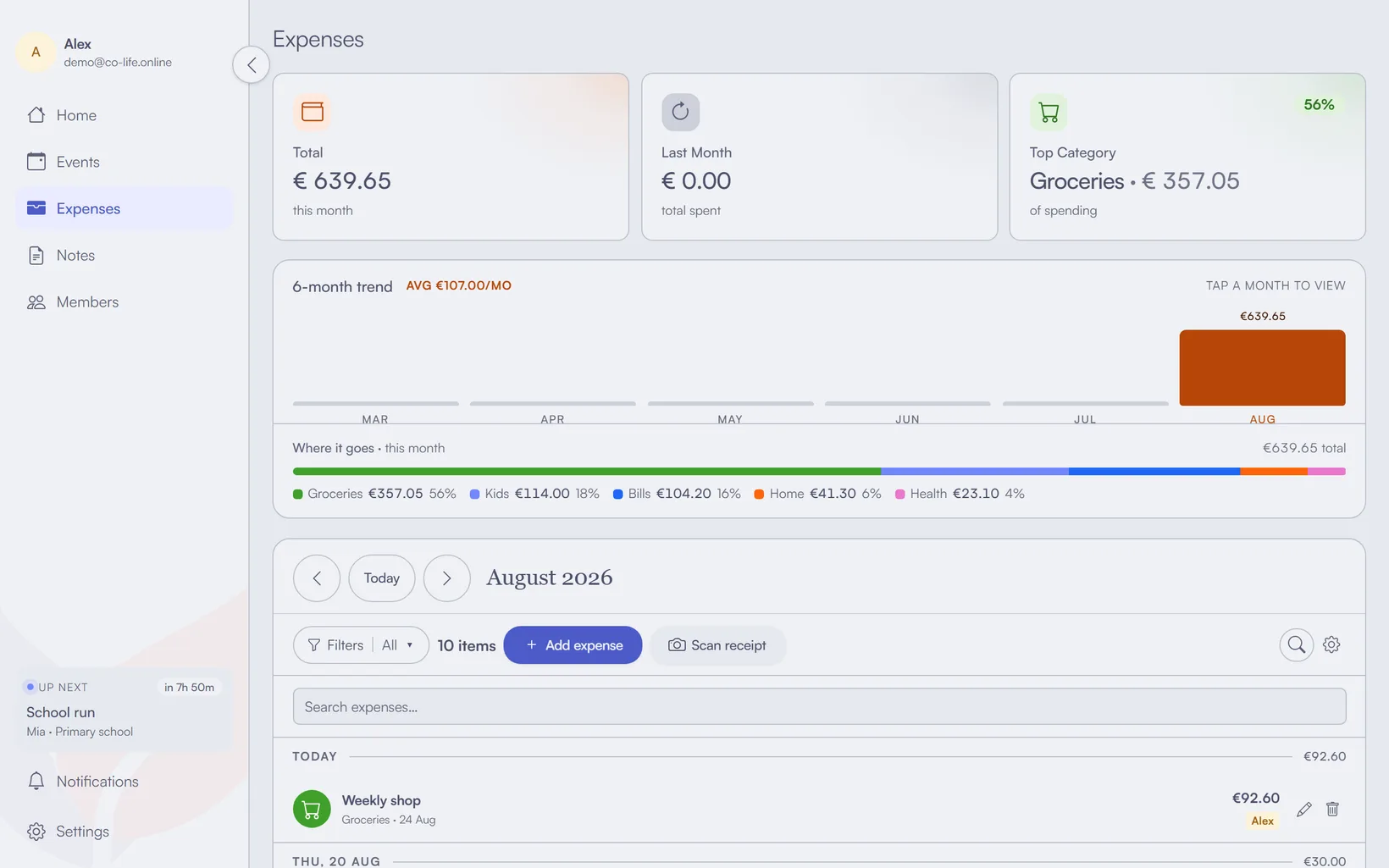
Both partners feel the same proportional squeeze, which is the point — €1,200 out of €3,600 hurts exactly as much as €800 out of €2,400. You don't recalculate this every purchase; you set the ratio once and only revisit it when someone's income actually changes. In co-life you can keep every shared cost in one place, tagged with who paid, and see each person's share of the month at a glance to check it against that ratio — instead of reconstructing it from memory at the end of the month.
Where should the shared money actually live?
Agreeing a ratio is half the job. The other half is deciding where the shared money physically sits, and there are three common setups.
- Yours, mine and ours. You each keep your own current account and open a third, joint one. Each person pays their agreed share into it on payday, and every shared bill leaves it by direct debit. Your own spending stays your own business. This is where most couples end up, because it separates our costs from my money without merging your entire financial life.
- One pot. Both salaries land in a joint account and everything comes out of it. It stops the arithmetic completely — but it only works if you genuinely agree about spending, because there is no private column left.
- No joint account at all. You keep separate accounts, one person pays a bill, the other transfers their share. It needs no setup, which is why nearly everyone starts here, and it needs the most tracking, which is why many people eventually move on.
Whichever you pick, automate the transfer. A standing order that moves your share into the joint account the day after payday means the split happens whether or not either of you remembers it. In the euro area a SEPA standing order costs nothing to set up, and shared-account features in apps like Revolut do the same job.
Choosing between those three carries more than the arithmetic does, including the liability you both take on the moment two names go on one account. There's a full walkthrough in the guide to joint bank accounts for couples, along with the shared costs a joint account never sees.
What counts as a shared expense?
Groceries are the hardest of these to pin down, being the most frequent and the least attributable. If that is the category causing the friction, how to budget for groceries deals with it on its own terms.
The argument that looks like it is about money is usually about this. Rent, utilities, groceries, household repairs and anything the home itself needs are treated as shared almost everywhere. Your phone contract, your clothes, your gym, your half of a night out with your own friends usually are not.
The awkward middle is the part worth settling out loud: takeaways, holidays, a car only one of you drives, a pet one of you brought into the household. There is no correct answer here — only an agreed one. Write the list down once, and add to it when something new turns up, rather than arguing about it after the money has already gone.
The part every guide skips: tracking who actually paid
Here's what turns a fair method into an unfair feeling. You agree on 60/40. Then real life happens: you grab the groceries on Tuesday, your partner covers dinner on Friday, one of you pays the whole electricity bill because it landed on your card. By the end of the month the split on paper is perfect and the split in practice is a mess — and that's the thing people actually argue about.
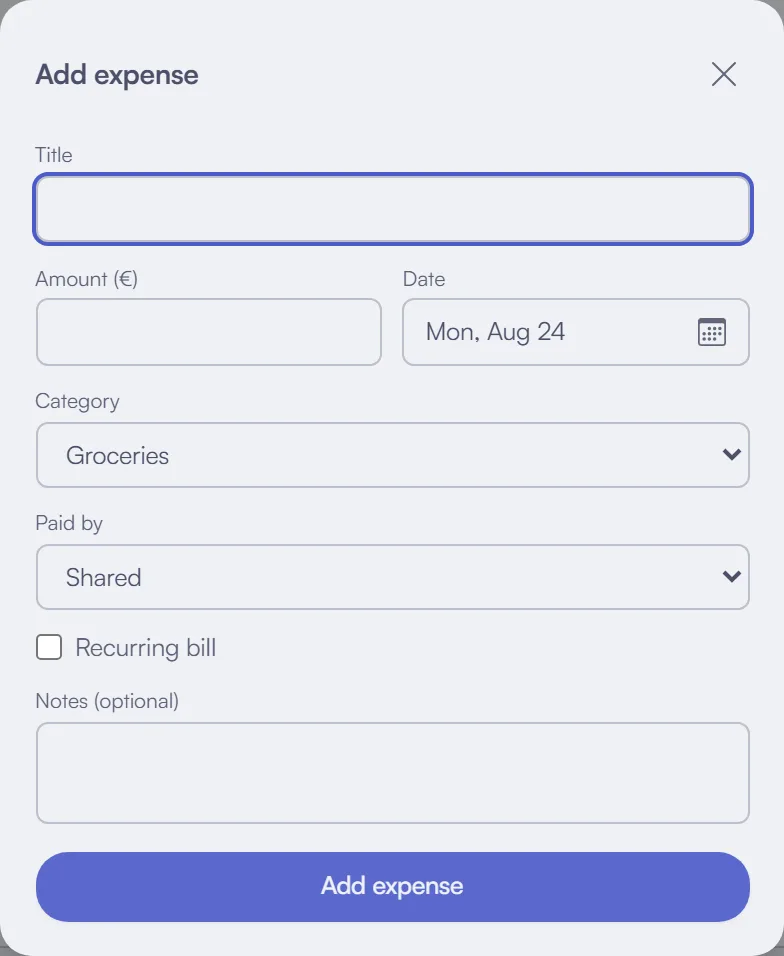
The fix isn't a better formula. It's a shared record of who paid. Every shared cost gets logged with who paid attached, so instead of two people reconstructing the month from memory, there is one list you both trust. In co-life every expense carries a "paid by" tag, and the month shows each person's share side by side — what you covered, what your partner covered, and anything nobody tagged. Fairness stops being a monthly argument and becomes something you can look up.
What if your situations aren't symmetrical?
Most guides assume two salaries and nothing else going on. Real households are messier, and the ratio has to bend for four common cases.
- One of you has debt. Student loans or a credit card are personal costs rather than household ones — but a proportional split calculated on gross income can leave the person carrying them with nothing left over. If that happens, run the ratio on income after debt repayments instead.
- One of you isn't earning. Parental leave, study, illness, a stretch between jobs. Proportional handles this on its own: a zero income means a zero share, and the household keeps running without anyone having to ask for it.
- One of you owns the home. If one person owns the property and the other pays "rent" into it, be explicit about what that money is — rent, or a contribution to a mortgage that builds one person's equity. This is the one that quietly causes resentment years later, and it costs nothing to say out loud now.
- Someone supports people outside the household. Money sent to parents or to children who live elsewhere is a real, fixed commitment. Treat it like any other unavoidable cost when working out what each person can genuinely contribute.
Step by step
- Agree on one method. 50/50 if your incomes are close, proportional if they're not, by-category if your fixed costs already balance. Decide together, and treat it as the default — not something you renegotiate per purchase.
- Put the fixed costs in first. Rent, utilities, subscriptions — the bills that repeat. In co-life these go in as recurring expenses, so they land every month without anyone re-entering them, and they anchor what "shared costs" even means.
- Log shared spending as it happens, with who paid. The ten-second habit that makes everything else work: when a cost touches both of you, add it and tag who covered it. From the phone, at the shop. If it's not logged, it didn't happen — and someone eats the cost silently.
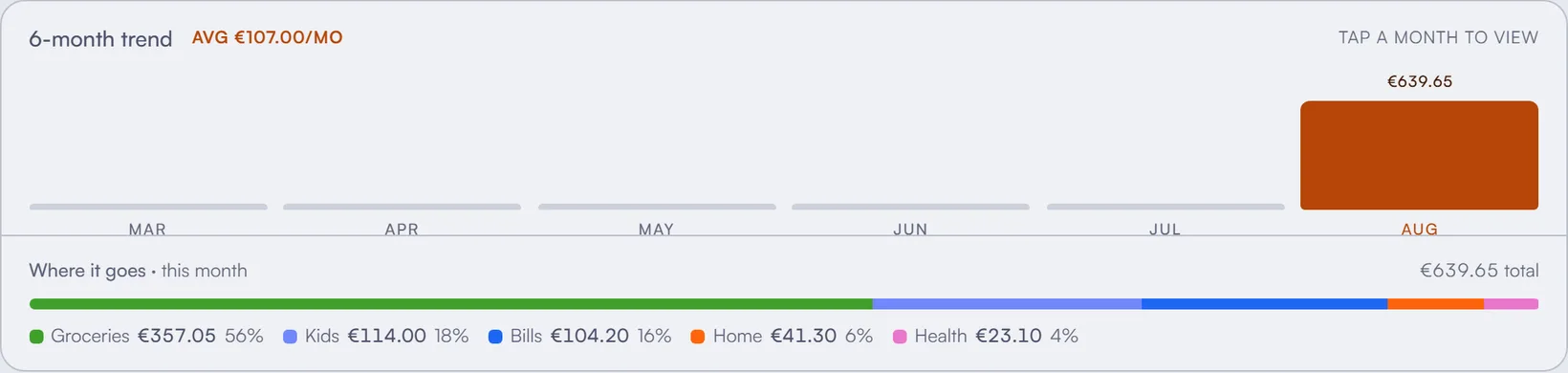
- Set a budget per category. Give groceries, eating out, and the rest a monthly ceiling so you spot the category that's quietly drifting before it distorts the split.
- Check the month, not every receipt. co-life shows what each of you paid for the month as a share, so you can see how it landed without re-reading individual entries — and anything nobody tagged shows as its own slice, which is a gentle prompt to tag the next one. Note the honest limit: it reports what was paid, but it does not know the ratio you agreed, so it will not tell you anyone is ahead or behind. If settling to the cent matters to you, a dedicated settle-up app — Splitwise, Tricount or Settle Up — does that job well, and there is no reason not to run one alongside.
- Revisit the ratio quarterly, not constantly. Incomes change, rent goes up. Re-check the split a few times a year on purpose, so it never silently stops being fair — and so it's a five-minute review, not a running argument.
One rule that keeps it fair
The method you pick matters less than this: decide the split once, make the balance visible, and stop settling it purchase by purchase. Keeping score is exhausting because it asks both of you to remember everything and trust that the other person is too. A shared, up-to-date total does the remembering for you — so the fair split you agreed on in a calm moment is the one that's still running three busy months later.
If you'd like somewhere to do exactly that — every shared cost in one place, tagged by who paid, categorised, budgeted, and exportable whenever you want the raw numbers — give co-life a try. It's free to start, EU-hosted, and built for two people (or a whole household) sharing one set of expenses. You can still export everything to a spreadsheet whenever you want the raw numbers — you just don't have to live in one.