 co-life
Rent is the easy part. It's one number, it arrives on the same day every month, and everyone agreed to it before they moved in. There's a whole method for dividing it by room size and a way to handle three or more people, which we covered in how to split rent fairly.
Then there's everything else, and everything else is where house-shares actually fall apart.
Washing-up liquid. The internet bill in one person's name. A €14 delivery charge for a shop that three of you ate. The guest who stayed nine days. The person who moves out in March still owing for February's electricity. None of it is large. All of it is frequent, and frequency is what turns money into a mood.
A house-share is different from a couple in two ways that matter here, and both push in the same direction. People leave, often at short notice. And you're sharing costs with someone you probably didn't know two years ago, which means the system has to work without a reservoir of goodwill to draw on.
What's the fairest way to split shared costs between roommates?
Split fixed bills equally, split consumables through a shared kitty everyone pays into, and log anything one person fronts on their own card. The split matters less than the record. Most house-share arguments are not about the method being wrong; they're about nobody being able to reconstruct who paid for what.
That last point is the whole guide, so it's worth being blunt about it. You can pick a slightly unfair method and be fine for two years if everyone can see the numbers. You can pick a perfectly fair method and be miserable by June if nobody can.
The three categories, and why they need different treatment
Shared spending in a house-share falls into groups that behave nothing alike, and treating them the same is the usual mistake.
| Type | Examples | How to handle it |
|---|---|---|
| Fixed and recurring | Internet, electricity, water, council tax, a cleaner | Equal split, one payer, standing order from everyone else on the same day each month |
| Consumables | Loo roll, dish soap, bin bags, salt, oil, cleaning stuff | A kitty. Do not itemise these |
| Food | The weekly shop, shared meals | Depends entirely on whether you actually eat together |
| One-offs | A new kettle, a plumber, the sofa | Agree before buying, log after |
The kitty row is the one people resist and the one that saves the most trouble. Splitting a €3 pack of sponges four ways is a rounding error that costs more in attention than it does in money. Everyone puts €15 a month into one pot, whoever's in the shop buys what's needed, and nobody thinks about it again. If the pot runs dry faster than expected, raise the number. That's the whole system.
The bill in one person's name
Almost every house-share has at least one utility that legally belongs to a single person. The internet is usually the worst offender, because it's on a contract with an early-termination fee and it outlives whoever signed it.
Three things worth doing on day one:
- Write down whose name is on what. Internet, electricity, water, the TV licence, the insurance. One list, somewhere everyone can see it.
- Make the reimbursement automatic, not requested. A standing order from each housemate to the bill-payer, dated the day after the bill leaves their account. A person who has to ask every month eventually stops asking and starts resenting.
- Agree what happens when they leave. The person whose name is on the contract carries the risk after they go. Say out loud who takes it over and when.
That third one is the expensive one. Someone moves out, the contract stays in their name, and they're still liable for a house they no longer live in, sometimes for another eight months.
When you eat together, and when you don't
Food is the biggest shared cost in most house-shares and the one with the widest range of arrangements. There are two that work and one that doesn't.
A shared food kitty works when you genuinely cook together most nights. Everyone pays in the same amount, one person shops, meals happen. It's simple, and it stops the till-receipt archaeology completely.
Fully separate food works when you don't. Own shelf, own shop, own labels if it comes to that. Slightly wasteful, entirely clear.
Splitting each shop as it happens is the one that doesn't work, and it's what most house-shares default to because it feels fairest. It requires someone to itemise a receipt where two people wanted oat milk, one is vegetarian, and someone bought shampoo in the same trip. Nobody sustains it past a few weeks, so it decays into an informal "it evens out", which is fine right up until someone decides it hasn't.
If your house is genuinely half-and-half, split the difference structurally: a kitty for staples that everyone uses (oil, rice, coffee, spices, cleaning) and separate shopping for everything else. The staples are the part that's annoying to attribute and cheap to share.
Log what you front, on the day you front it
Here's the pattern that produces most house-share money resentment, and it's almost never anybody behaving badly.
You pay the €96 electricity bill because it's in your name. Two weeks later a housemate buys a €40 replacement for the broken toaster. Someone else covers a €25 chimney sweep call-out. Each of you remembers your own contribution clearly and the others' vaguely, because that's how memory works. Four months later, every person in the house sincerely believes they've put in more than their share, and every one of them is arguing in good faith.
There's no method that fixes this. The only fix is a record, kept at the moment of spending rather than reconstructed later.
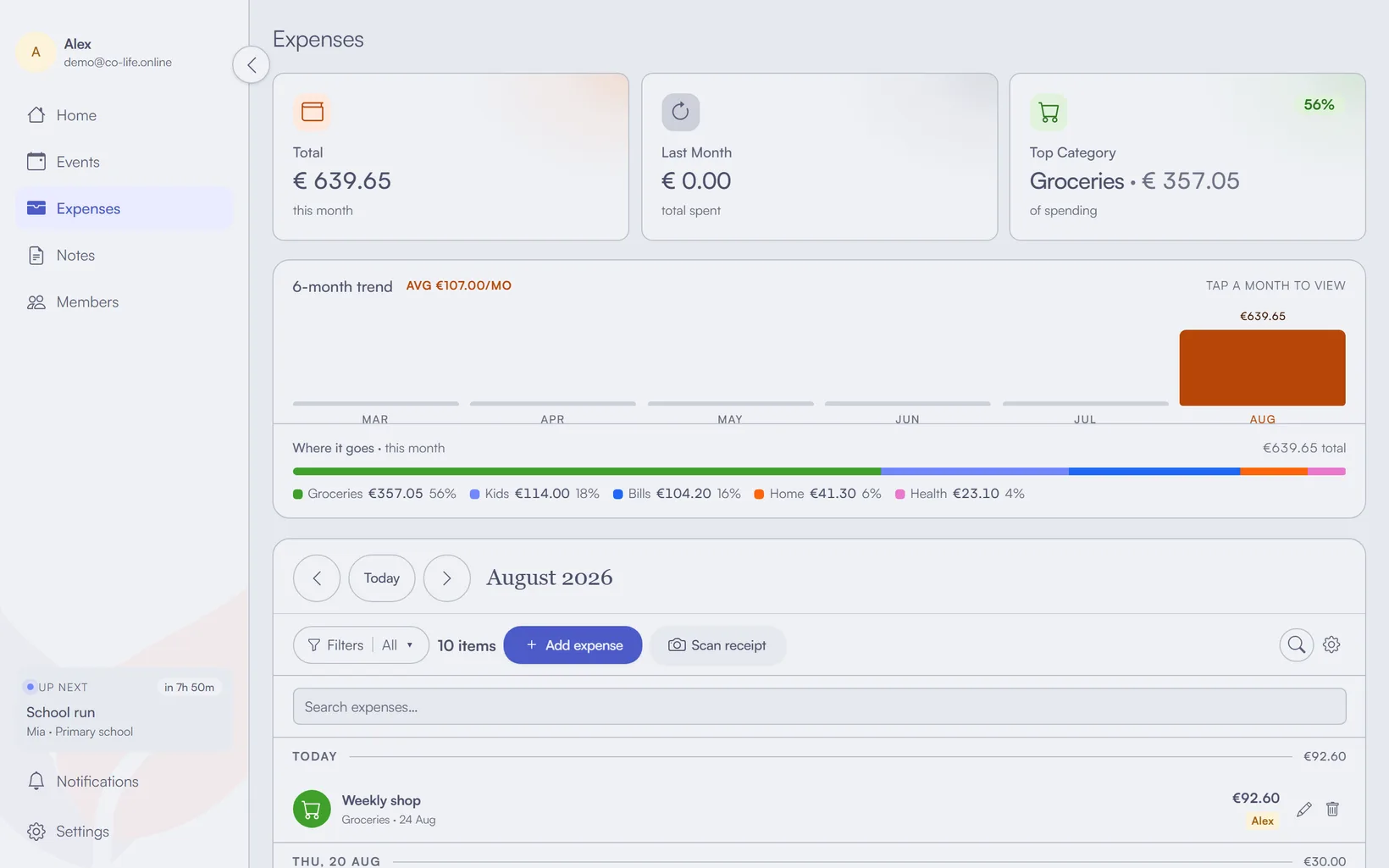
That's what co-life does with household expenses: anything one person fronts gets logged with who paid attached, and anything from the kitty or a joint card is tagged as the household's rather than any individual's. At the end of the month, the Expenses screen shows each person's share of what the house actually spent, alongside where it went by category. You get one list everyone can look at instead of four private mental ledgers that disagree.
Two honest limits, because this matters more for a house-share than for a couple. co-life has no settle-up. It shows what each person contributed; it will not compute that Sam owes Alex €43.50 and chase it. That's a deliberate product decision, and for a couple it's the right one. If your house wants a running who-owes-whom ledger settled every month, use Splitwise or Tricount instead — they do that job properly and co-life doesn't try to. co-life suits a house that shares a kitty and wants everything in one place with the calendar and the notes, rather than one that tallies to the cent.
The second limit: there's no bank connection. Expenses are added by hand or photographed from a receipt.
More on the tracking side, without any shared account at all: how to track shared expenses without a spreadsheet.
The house meeting nobody wants to have
Set a date each month. Fifteen minutes, in the kitchen, ideally before anyone's annoyed. Read out what the house spent, confirm the kitty level, and deal with anything odd while it's still small and unembarrassing.
The reason to schedule it rather than call one when needed: a meeting called when needed is, by definition, a meeting about a grievance. A meeting that happens on the first Sunday of every month is admin. The same conversation costs nothing in the second format and costs a friendship in the first.
When someone moves out
The one genuinely adversarial moment in a house-share, and it always arrives faster than expected.
- Settle before the keys go back, not after. Once somebody's things are out of the house you have no way to press the point, and chasing a former housemate for €70 across a city is a lost cause you'll spend three weekends on.
- Deposits are not a slush fund. The deposit belongs to whoever paid it and is returned by the landlord under its own rules. Do not net unpaid bills off someone's deposit informally; that's the fight that ends up in a tribunal.
- Deal with the contract, not just the money. Whoever's name is on the internet, the energy account and the tenancy needs to change or be formally accepted by the person staying.
- Note the meter readings on the day. Energy bills arrive weeks late, and an estimated bill spanning a move-out is unsplittable after the fact.
Write it down while everyone's still friendly
None of this needs a contract. It needs one page, agreed in the first week, that says: what's split equally, what comes out of the kitty, how much the kitty is, whose name is on which bill, when the house meeting is, and what happens when someone leaves.
Write it while everyone likes each other. That document costs twenty minutes at the start of a tenancy, and it is worth roughly one avoided argument per month for as long as the house exists.
If you're setting up a new house-share, do the kitty first and the rest later. It removes the highest-frequency, lowest-value category of decision immediately, and it's the change people notice within a fortnight.
Keeping the household's spending, calendar and notes in one place, with every expense tagged to whoever paid, is what co-life is for.