 co-life
Almost every page you'll find on this asks the same question, what should a household spend on groceries?, and answers it with a number.
The number is nearly always American, usually derived from the USDA food plans, and it will not help you.
Not because it's wrong. Because of what it is. The USDA publishes four food plans (Thrifty, Low-Cost, Moderate-Cost and Liberal) and they're built from quartiles of what Americans actually spend, then adjusted each month for inflation using CPI-U. The Thrifty plan sets the maximum SNAP allotment. The Low-Cost plan is what US bankruptcy courts use to decide a reasonable food budget.
So when a budgeting site tells you two adults should spend a certain amount, it is telling you where American households sat in a spending distribution, converted into advice. That is a fact about other people's shopping, in another currency, at another set of prices. It is not a target, and treating it as one is how people end up feeling bad about a perfectly reasonable grocery bill.
Here's what to do instead.
How much should a household spend on groceries?
Start from your own numbers, not a national average. Add up the last three months of grocery spending and divide by three. That's your real baseline. Set your first budget at that figure, not below it. Only once you can see the number reliably, month to month, is it worth trying to move it.
The reason for that order is that almost everybody guesses low. Ask two people what they spend on food and you'll get an answer that's out by a third, because the weekly shop is memorable and the four midweek top-up trips are not. A budget set from a guess is a budget you fail in week two, and a target you miss every month stops being information.
Step one: find out what you actually spend
Three months is the minimum honest window. One month is distorted by whatever happened that month; a fortnight tells you nothing at all.
Two things to get right while you count:
Count top-up shops. The €9 dash for milk and bread, three times a week, is often 20–30% of the real total, and it's invisible if you only think in terms of "the big shop".
Decide where the line sits, and hold it. Is a takeaway groceries or eating out? Is wine? Is the dog food? Is washing-up liquid, given it's on the same receipt? There's no right answer, but there's a consistent one, and consistency is what makes month-to-month comparison mean anything. Write the rule down.
If you're tracking a household rather than yourself, this is also where you find out how much of it is invisible to the person who doesn't do the shopping. That gap tends to be the real subject of grocery arguments.
Step two: set a budget you'll actually hit
Set it at your three-month average, not below it. If you want the number to come down, reduce it deliberately in the second or third month, once you have a baseline you trust.
A budget slightly above your average for the first month is not a failure of ambition. It's the only way to find out whether your baseline was right, and it beats setting an aspirational number, blowing through it by the 18th, and concluding that budgeting doesn't work.
The widely repeated rule of thumb, keeping groceries to 10–15% of take-home pay, has an obvious flaw as a target: it scales with your income rather than with the number of people you're feeding or what food costs where you live. A household of four on a modest income will blow past 15% while shopping carefully; a well-paid couple can sit at 6% eating whatever they like. It's a rough sanity check, not a goal.
The levers that actually move the number
In rough order of how much they change, based on the mechanics rather than on willpower:
- Where you shop. The single largest factor, and the one requiring the least discipline. Moving a regular shop to a discounter changes the total by a fifth or more, permanently, with no ongoing effort.
- How often you shop. Fewer, larger trips beat frequent top-ups, because each unplanned trip carries a tax of things you didn't come in for. This is also the one that reduces food waste most.
- A meal plan, even a rough one. Not a spreadsheet of every meal. Four or five dinners decided before you shop, which is enough to stop the "we have ingredients but no meals" problem that ends in a delivery order.
- What proportion of the money is meat and prepared food. The largest per-meal cost difference in most baskets, and the lever most guides lead with. It's real, but it's slower and requires more sustained attention than the first three.
- Waste. A third lever disguised as a virtue. Watching what goes in the bin for two weeks is unpleasant and unusually informative.
Notice what isn't on that list: coupons, loyalty points, and switching to own-brand on individual items. They work, they're just small relative to the effort, and they demand attention every single shop rather than once.
Groceries are the hardest shared expense to attribute
For a household, there's a second problem underneath the budgeting one, and it has nothing to do with the total.
Groceries are the most frequently shared, most frequently split, and least attributable category of household spending. One person goes on Tuesday, the other on Saturday. Someone buys shampoo and cat litter on the same receipt as the vegetables. A shop nominally "for the house" contains four things only one person eats.
Which means at the end of a month, two people who both shop regularly usually have very different impressions of who has been feeding the household. Both impressions are sincere, and neither is checkable. This is the same mechanism described in how to split household expenses fairly, and groceries are where it bites hardest, because the transactions are small and constant.
There are two workable answers, depending on your household.
A food kitty. Everyone pays a fixed amount into one pot, the shopping comes out of it, and nobody attributes anything. The right answer for house-shares, and covered in how to split expenses with roommates.
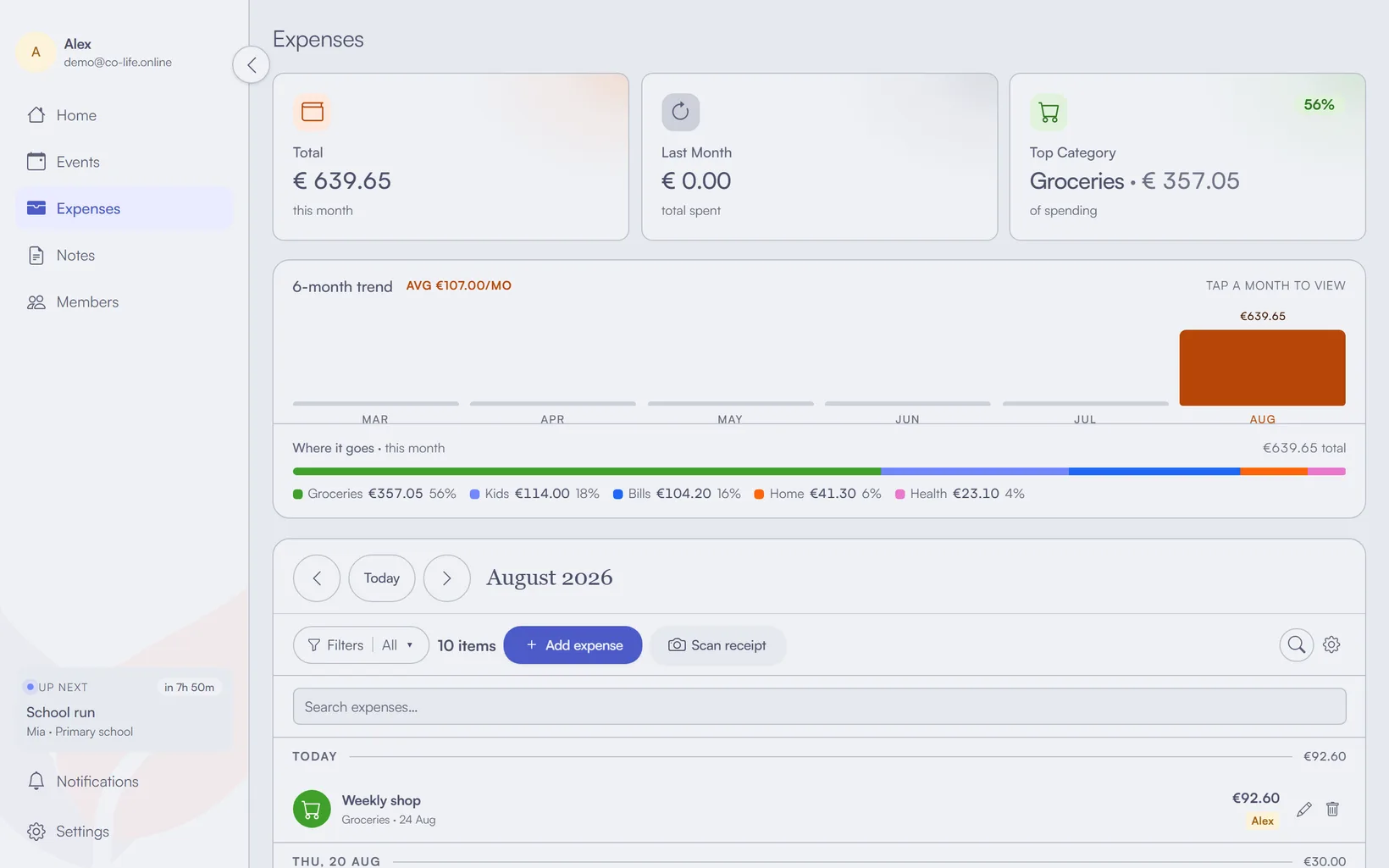
Tag every shop with who paid. Better for couples and families, because it keeps the flexibility of whoever-is-passing-the-shop while still producing a record. That's what co-life does: each expense carries a paid by tag and a category, so Groceries becomes a line you can see over six months rather than a feeling. You can photograph the receipt instead of typing it in, and set a monthly budget for the category so the number is visible mid-month, when you can still act on it, rather than as a surprise on the 31st.
Worth saying plainly: there's no bank connection, so this only works if the shop gets logged. Receipt capture makes that quick, and it is still a habit rather than magic. And co-life shows what each person contributed without computing who owes whom. That is a deliberate choice, and it matters here, because a per-person tally on a category as blurry as groceries is exactly where scorekeeping starts.
What a realistic first three months looks like
Month one: measure only. Change nothing about how you shop. Log everything, including the top-ups. Expect the total to be higher than you'd have guessed.
Month two: set the budget at that number and pick one lever. One. Almost certainly where you shop, because it's the one that keeps working while you're not thinking about it.
Month three: compare. Look at the two months side by side rather than at whether you hit a target. The trend is the useful information; the monthly figure is noisy, because a big stock-up shop lands in one month and feeds you into the next.
After that it's maintenance, and the maintenance is mostly not re-litigating the number every week. Set it, look at it once mid-month, adjust it in a season rather than in a fortnight.
If you only do one thing from this guide, do month one. Most households discover their real grocery number is 20–30% away from what they believed, in one direction or the other, and every decision after that is better for knowing it.
When the number won't come down
Sometimes the budget isn't the problem. Food prices move independently of anything you do, and a grocery bill that rose 15% in a year is usually telling you about prices rather than about your shopping.
That's worth naming, because there's a genre of budgeting advice that treats every overspend as a discipline failure. If you've measured three months, moved your shop, planned meals, and it's still high, the honest conclusion may be that this is what feeding your household costs right now. That's information for the rest of your budget, not a reason to keep squeezing the one category that's already been squeezed.
Keeping the household's spending in one place, tagged and categorised so trends are visible rather than remembered, is what co-life is for.