 co-life
Rent is usually the largest single thing a household pays for, and the one where splitting it fairly and splitting it equally come apart fastest. Two people paying half each is obviously fair when they share everything. It stops being obvious the moment one bedroom is twice the size, or one of them gets the room over the street and the other gets the quiet one at the back.
This guide is about that gap. The general methods for splitting household expenses fairly apply to rent as much as to groceries — but rent has a wrinkle none of the others do: you are not just dividing a cost, you are dividing an unequal thing that the cost buys.
How do you split rent fairly?
Start from the split you have already agreed for everything else — evenly, or in proportion to income — and only adjust it if the rooms are genuinely unequal. When they are, the usual method is to weight each person's share by the floor area of their private space and divide the shared rooms equally on top. For three or more people, ask everyone to price the rooms independently instead.
The square-metre method, and where it stops working
The mechanical version is simple. Measure the private rooms. Split the shared space — kitchen, living room, bathroom, hallway — equally between everyone. Then each person pays their private area plus their equal slice of the shared area, as a fraction of the total.
Say the flat is 70 m². Bedroom A is 16 m², bedroom B is 10 m², and the remaining 44 m² is shared. On a rent of €1,000:
| Private | Shared slice | Total | Pays | |
|---|---|---|---|---|
| Person A | 16 m² | 22 m² | 38 m² | €543 |
| Person B | 10 m² | 22 m² | 32 m² | €457 |
That is defensible, it takes ten minutes, and it settles most arguments before they start.
It also quietly assumes that a square metre is a square metre, and everyone who has actually lived in a flatshare knows that is false. A 10 m² room with a window onto a courtyard and a built-in wardrobe can be plainly nicer than a 16 m² room facing a tram line. If you run the numbers and one of you feels short-changed, the numbers are not wrong — they are just measuring the wrong thing.
What actually makes a room worth more
Before you argue about the total, it helps to agree on what you are pricing. Floor area is only the most measurable factor, not the most important one:
- Light and aspect. Which way the window faces, and whether anything blocks it.
- Noise. Street versus courtyard, and whether the room shares a wall with the living room or the lift.
- Storage. A built-in wardrobe is a square metre you do not have to furnish.
- Private bathroom, if one room has one and the others do not. This is usually the single largest premium.
- Access. A room you walk through to reach another room is worth noticeably less.
- Who is home when. A person who works from home uses the flat far more hours than someone who does not, which is a real difference that floor area cannot see.
None of these have objective prices. That is exactly why the next method exists.
Three or more people: let everyone price the rooms
Once there are three of you, arguing room by room does not converge. There is a better approach, known as envy-free rent division, and the mechanism is easier than the name.
Everyone privately writes down what they would pay for each room, with their numbers adding up to the total rent. Then you assign rooms so that each person gets the room they valued most highly relative to what they will pay. Done properly, nobody prefers someone else's room-and-price combination to their own — which is what "envy-free" means, and it is a far stronger guarantee than "we all grudgingly agreed".
The practical version for a household that does not want to do maths: everyone bids independently, you compare the sheets, and in most cases the answer is obvious because people genuinely want different things. The person who works nights wants the quiet room and does not care about light. The disagreements that survive that exercise are the real ones, and they are much smaller.
The important part is independently. If you price the rooms out loud, together, the first number said anchors everyone else and you have learned nothing.
Deposits are not rent, and should not be split like rent
A deposit is not a cost, it is money you are holding somewhere else — so it should come back to whoever put it in, in the proportion they put it in. Write that down on the day it is paid, not on the day you move out.
The same goes for one-off setup costs: the agency fee, the first shop, the drill somebody bought. Decide once whether those are shared or personal, and record who paid. Tracking shared expenses without a spreadsheet covers the mechanics; the point here is only that they are a separate question from the monthly split.
If you are moving in and this is all still ahead of you, the moving-in-together checklist has the tenancy and deposit conversation in full — including whose name goes on the lease, which matters more than the split does.
Do the bills follow the same split?
Usually not, and assuming they do is a quiet source of friction.
Rent pays for space, so splitting it by room makes sense. Utilities pay for use, and use does not track floor area at all — the person working from home five days a week runs the heating and the kettle far more than the person who is out from eight until seven, whatever size their bedroom is.
Three approaches, in ascending order of effort:
- Split bills evenly, rent by room. The most common answer and usually the right one. It keeps the fiddly calculation confined to the thing that is genuinely unequal.
- Split everything by the rent ratio. Simpler to remember, one number for everything. Fine when the rooms and the usage happen to line up.
- Split heating and electricity by who is actually home. Worth it only in the clear case — someone working from home full time while the other commutes — and even then it is a conversation, not a formula.
Internet and any household subscriptions are the easy ones: everybody uses them equally, so split them evenly regardless of what you did with the rent.
When one person moves out
In a flatshare this is the moment the rent split gets tested, and it is worth agreeing the rule before you need it.
Rent is only the part of a flatshare's money that everyone agreed to up front. The bills, the kitty and the consumables are handled separately in how to split expenses with roommates, including what to settle before someone hands their keys back.
Two things to settle in advance. Does the incoming person inherit the outgoing person's room and price, or do you re-run the split? Re-running is fairer — the flat's rooms have not changed but the people valuing them have — and it is much easier to say that now than to propose it when someone has already packed. And who returns the deposit share? In most tenancies the landlord holds it until everyone leaves, so the outgoing person is usually repaid by the incoming one directly. That is a real transfer between two people and it belongs in writing.
If your names are all on one tenancy, remember that leaving does not automatically remove someone from it. That is a paperwork question for the landlord, not a household one, and it outlives the rent split entirely.
Write down the answer, once
Whatever you land on, the failure mode is the same as with every other shared cost: you agree it in a calm moment, and six months later nobody can remember whether the €40 difference was about the wardrobe or the bathroom. Put the split and the one-line reason somewhere both of you can see. Then it is a decision you made together rather than a number one of you has to defend.
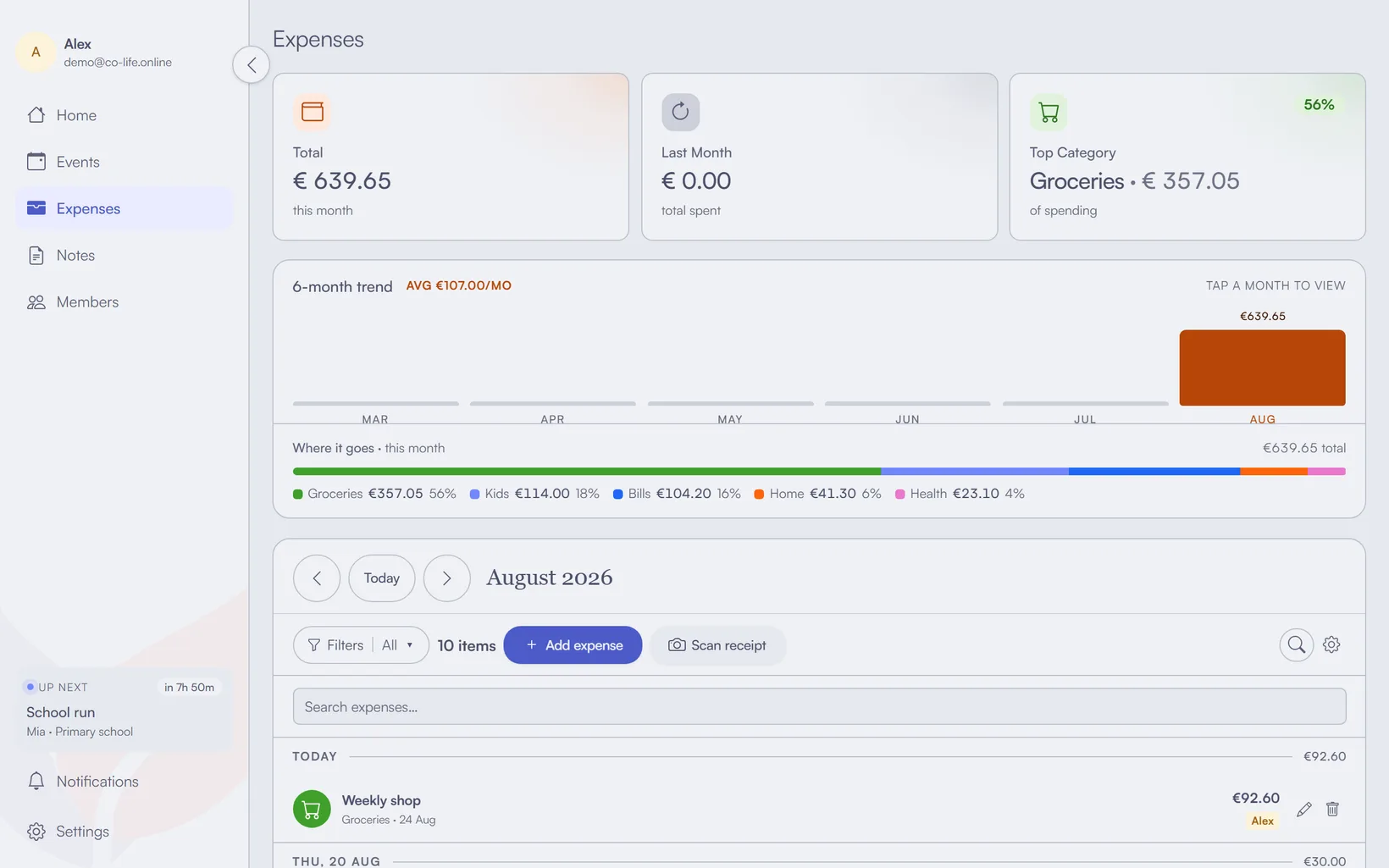
In co-life you can enter rent once as a recurring expense so it appears every month on its own, tagged with who paid it, alongside everything else the household spends. It records what happened; the fairness is still yours to agree.
Revisit it when the flat changes, not when the mood does
A rent split should be stable. Re-open it when something real changes — someone swaps rooms, a partner moves in, one person starts working from home five days a week, the rent itself goes up. Do not re-open it because of a bad week.
Agreeing in advance when you will revisit is what makes that possible: say "we'll look at this again if anything about how we use the flat changes", and the question stops hanging over every conversation about money.
If you would like one place to hold the rent, the bills and everything else the household shares — entered once, tagged by who paid, and visible to both of you — give co-life a try. It is free to start, EU-hosted, and built for the people who share a home rather than for splitting a single trip.