 co-life
Almost every guide to dividing household chores fairly ends at the same place: a chart. Columns for each person, rows for each task, ticks down the side. People make them with real enthusiasm, and they work for about a month.
They stop working because a chart schedules the doing, and the argument in a shared home is almost never about the doing. Nobody resents thirty minutes of vacuuming. What builds up is being the person who noticed the floor needed doing, remembered the bags were nearly out, and worked out when there was a free hour for it. A chart divides the visible half of the work and leaves the invisible half exactly where it was — which is why the person who was already carrying it usually ends up maintaining the chart too.
How do you divide chores fairly?
Split ownership of whole jobs rather than individual tasks, and make sure owning a job includes noticing it needs doing, planning it, and doing it. Write down the invisible jobs — booking services, tracking what is running low, remembering renewals — alongside the visible ones, because those are the half that usually goes uncounted. Agree your standards out loud once.
Write down the invisible half first
Before dividing anything, spend twenty minutes listing what actually keeps the home running. Do it together, and write both kinds of job in the same list:
- Visible: cooking, dishes, laundry, vacuuming, bins, bathroom, shopping.
- Invisible: noticing supplies are low and adding them to the list. Booking the boiler service, the dentist, the car. Tracking when insurance renews. Knowing which school form is due. Remembering that the tap has been dripping for a fortnight. Deciding what is for dinner — not cooking it, deciding it.
Most households find the second list is longer than they expected, and that it belongs almost entirely to one person. That discovery is usually the most useful part of the whole exercise, and it happens before anyone has divided anything.
Whoever owns a job owns noticing it
This is the one rule worth taking from the literature. Eve Rodsky's Fair Play sets it out most sharply: whoever holds a task owns conceiving, planning and executing it — spotting that it needs doing, working out how, and doing it. All three, or none.
That rule is what kills the most common failure in shared homes: "I'll help, just tell me what needs doing." It sounds cooperative and it is not, because it keeps the whole noticing-and-planning layer with the person who was already carrying it and hands over only the easy third. Someone who owns "the car" books the service, knows when it is due, and deals with it. Someone who helps with the car waits to be asked.
It also means you divide jobs, not tasks. "Bins" is a job — knowing which bin goes out which night, and that the bags are running low. "Take the bin out tonight" is an instruction, and an instruction has to come from somebody.
Three ways to divide, honestly
There is no correct method, only one that suits how your week actually looks.
- By ownership. Each person owns whole jobs, permanently. Clearest accountability and the least ongoing negotiation, which is its real advantage. The risk is drift into stereotype: check that the split you land on is not just the one you would have defaulted to anyway.
- By rotation. You swap jobs weekly or monthly. Fairer-feeling, and everyone learns what everything actually involves — which quietly settles a lot of arguments about how long things take. But it needs a tracker to work, and the noticing resets every time the job moves.
- By availability. Whoever has time does the thing. Genuinely the best option for households with irregular shifts, and the worst for everyone else, because "whoever has time" reliably means "whoever notices first", which means the same person.
Most households that stay happy use ownership for the recurring jobs and availability for the one-offs. That is not a compromise; it is using each where it works.
The argument under the argument is standards
A surprising share of chore conflict is not about who does something but about what "done" means. One person's clean kitchen is wiped surfaces and an empty sink. Another's includes the hob. Neither is wrong, and neither is obvious to the other person, so it gets discovered by friction — usually as a comment about the hob that lands as a comment about effort.
Say the standards out loud, once, for the handful of jobs where you suspect you differ. You do not have to agree on them. You have to know, so that the gap is a known difference rather than a repeated small disappointment. If the person who cares more about the hob owns the kitchen, the problem disappears entirely.
When it is already unequal
Most people reading this are not dividing chores for the first time. They are trying to fix a split that has quietly become lopsided, and that is a harder conversation because it starts with an imbalance one person has been absorbing.
Two things make it go better. Do the list first, before proposing anything — an argument about fairness in the abstract goes nowhere, and the same conversation held over a written list of thirty jobs is a different conversation, because the imbalance is on paper instead of being a claim one person is making about the other. And hand over whole jobs, not help — offering to help more keeps the noticing where it was, which is the part that was heavy.
Expect a transfer period. Someone taking over a job they have never owned will do it worse for a month, forget things, and need the other person not to step in. Stepping in is what returns the job. That month is the actual cost of rebalancing, and it is worth paying once.

What the two lists look like in practice
Abstractly, "write down the invisible jobs" is easy to agree with and hard to act on. Here is roughly what a two-person household ends up with, so you can start from something rather than a blank page.
| Job | The visible part | The part that is actually the work |
|---|---|---|
| Groceries | The shop | Knowing what has run out, and what the week needs |
| Bins | Carrying them out | Which bin, which night, and the bags |
| The car | Driving it | Service due, insurance renewal, the odd noise |
| Kids' school | The drop-off | Which form, which trip, whose turn to reply |
| Repairs | The plumber's visit | Noticing, choosing a plumber, being in for them |
| Dinner | Cooking | Deciding, every single day |
Read the right-hand column on its own. That is the list nobody writes down, and in most households it is held by one person entirely — often the same person who is also doing a fair share of the left-hand column. Once it is on paper, the conversation stops being about effort and becomes about a specific, dividable set of things.
When only one of you cares
There is an honest case the standards conversation does not cover: sometimes one person genuinely does not mind. The kitchen could go two days and it would not bother them. That is not laziness, it is a different threshold — but it creates a real asymmetry, because the person with the lower tolerance will always crack first, and "I did it because you never would have" is where resentment starts.
Two ways through it that are not "the tidier person just does more":
- The higher standard owns the job. If you want the hob done daily, you own the kitchen and you get to do it your way. The other person owns something else entirely, at their own standard, and you do not comment on it. Traded, not conceded.
- Agree a floor, not an ideal. Not "the kitchen is spotless" but "no dishes left overnight". A floor is checkable and it is a promise someone can actually keep. Anything above it is a preference, and a preference is yours to satisfy yourself.
What does not work is one person quietly doing more and hoping it registers. It does not register — that is the definition of invisible work.
Revisit it, on a schedule
Any division drifts. Someone changes jobs, a child starts school, one of you starts commuting again. Put a reminder in for a few months out and take fifteen minutes to ask one question: is this still roughly even?
Having a scheduled moment matters more than the review itself. It means neither of you has to raise it out of frustration, which is the version of this conversation that goes badly. Knowing there is a date for it takes the charge out of the whole subject in the meantime.
Put it somewhere you both see
Whatever you divide, the split only holds if it lives outside one person's head. That is the same argument as running a household when both of you work, and it is why a shared surface beats a better chart: recurring jobs written down once, with a due date, stop being something anyone has to remember.
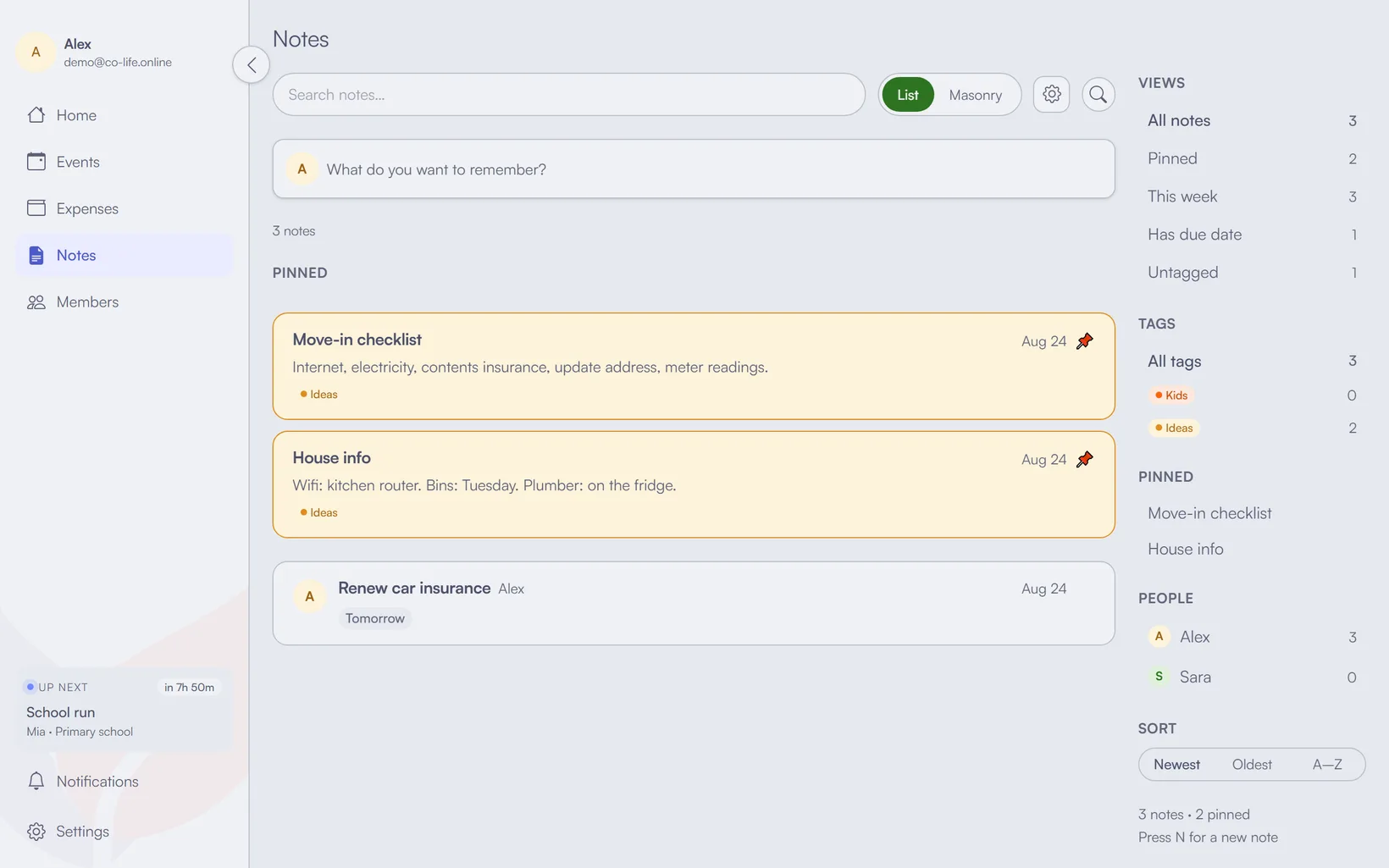
In co-life the invisible list lives in shared notes with due dates, and anything on a schedule — the boiler service, the car, the insurance renewal — goes in the shared calendar as a recurring event, so it arrives on its own instead of arriving because someone remembered. If you are setting all this up as you move in together, the moving-in checklist has the conversation in its proper place.
The goal is not a perfectly measured household. It is one where fewer things depend on one person quietly keeping track — give co-life a try if you would like somewhere to put them. Free to start, EU-hosted, no ads.