 co-life
Ask most people what happens legally when an unmarried couple who've lived together for nine years split up, and they'll tell you about common law marriage.
There is no such thing in England and Wales. In the 2019 British Social Attitudes survey, run by the National Centre for Social Research, 46% of people believed cohabiting couples form a common law marriage. That figure has barely moved in fourteen years, and it's higher among households with children, at 55%. As Anne Barlow, Professor of Family Law and Policy at Exeter, put it: cohabitation grants no general legal status to a couple.
Which means a large number of people are making the biggest financial commitment of their lives on the basis of a protection that doesn't exist.
A cohabitation agreement is the document that fills that gap. This guide covers what's actually worth putting in one, what varies too much by country for anyone to tell you online, and the larger part of this subject that needs no lawyer at all.
This is not legal advice, and it can't be. Whether a cohabitation agreement is enforceable at all, what it may cover, and what formalities it needs vary enormously between countries and even between regions. Use this to work out what you want to agree. Then take that to a lawyer where you live.
What is a cohabitation agreement?
A cohabitation agreement is a written contract between two people who live together but aren't married or in a civil partnership. It records who owns what, how the shared costs work, and what happens to both if the relationship ends. Its purpose is to replace, by agreement, the default protections that marriage would have supplied automatically.
That framing is worth keeping in view, because it explains why the document feels unromantic and why it isn't. Married couples don't negotiate this. They get a large, elaborate, state-supplied default set of rules covering property, maintenance and inheritance, and most of them never read it. An unmarried couple gets a much thinner default, so anything they want beyond it has to be written down.
The part that actually needs a document
Four areas carry real financial consequence, and they're the ones a lawyer will want to talk about.
The home. Who owns it, or whose name is on the tenancy. If one of you owns it and the other contributes to the mortgage, say explicitly whether those payments buy a share, and if so how much. This is the single biggest source of cohabitation disputes: someone pays into a property for years, assumes that builds an interest in it, and discovers otherwise at the worst possible moment.
Contributions that aren't cash. One partner renovating the kitchen, or leaving a job to care for a child, or paying all the bills so the other can pay the mortgage. These transfer real value and leave no paper trail. If they're meant to count for something, they have to be recorded at the time.
What comes in with each of you, and what you build together. Separate before, separate after, is the usual starting point. Things bought jointly need a rule, especially large ones such as a car.
Death. The one people skip, and the one with the harshest defaults. In many jurisdictions an unmarried partner inherits nothing automatically, no matter how long you lived together, and may have no say in funeral arrangements. A cohabitation agreement is not a will and does not replace one. Write both.
What varies too much to look up
Some of the most consequential questions have no general answer, and anyone online who gives you one is guessing about your country:
- Whether the agreement binds a court at all. In some places these are contracts and are enforced. In others they carry weight but a judge can set them aside, particularly where children are involved.
- What formalities it needs. Signatures, witnesses, notarisation, independent legal advice for each partner, full financial disclosure — the requirements differ, and missing one can void the whole thing.
- Whether anything about children can be agreed in advance. Very often not. Arrangements for children are usually decided on the child's welfare at the time, and no private contract overrides that.
- What rights accrue with time. Some jurisdictions grant unmarried partners rights after a set period of living together or after a child arrives. Others grant none, ever.
Two other things to settle early: whether you need one agreement or two documents, since property is often handled by a separate declaration of trust, and whether one lawyer can act for both of you. In many places they can't, and an agreement drafted without independent advice on each side is easier to challenge later.
The bigger half, which needs no lawyer
Here's the thing the legal guides on this subject miss. The agreement covers the catastrophic case, and it's the right instrument for that. But almost nothing that makes living together hard is catastrophic. It's the ordinary running of the place, and none of it belongs in a contract.
Nobody's relationship failed because their declaration of trust was imprecise. Plenty have eroded because one person carried the invisible work for four years, or because the bills quietly landed on whoever noticed first.
So write the agreement, and separately, agree the ordinary things:
- How the shared costs are split, and whether it's equal or proportional to income. The arithmetic is in how to split household expenses fairly.
- Where the shared money lives. Joint account, separate accounts, or the hybrid most couples land on. Covered in the guide to joint bank accounts for couples.
- Who does what, and who notices what needs doing. The second half of that sentence is the part that gets skipped and the part that causes the trouble. See how two working people run a household.
- What you'd each want if one income stopped. Illness, redundancy, parental leave. Agree it while it's hypothetical.
None of that needs a solicitor. All of it needs writing down somewhere you'll both actually look, which in practice means not a document nobody opens after the day it's signed.
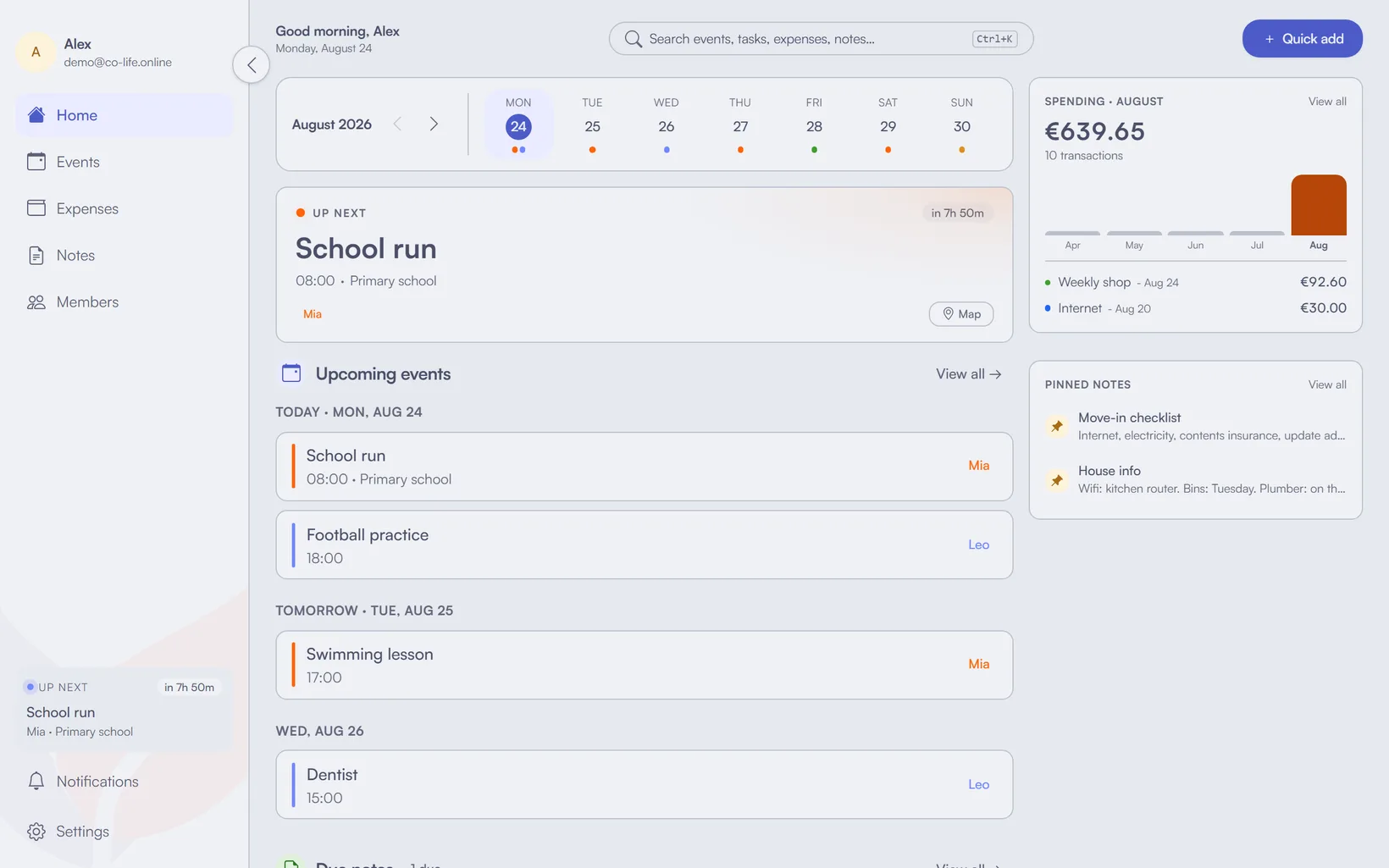
Keeping the ordinary agreements visible is the part co-life helps with: a shared note for what you've agreed, a shared calendar so the load is legible, and expenses tagged with who paid so the money side is a fact rather than a recollection. It is not a legal tool and it does not store or produce agreements. The document goes to your lawyer; the running of the household is what stays in the app.
When to write one
The honest triggers, in rough order of urgency:
- Before buying property together, always. This is the one case where nearly every family lawyer would say do not proceed without one.
- When one of you moves into a home the other owns. The moving-in partner has the most to lose and usually the least protection.
- When one of you steps back from paid work. Caring, part-time hours, or a move for the other's job. That decision transfers value with nothing to show for it.
- When a child arrives, which changes both the financial picture and, in some places, the legal one.
- On a schedule, if none of the above happens. Revisit every few years, or when something material changes. An agreement describing a life you no longer live is a liability rather than a protection.
If you're at the earlier stage of this — deciding whether to move in at all, and what to sort out first — start with the moving in together checklist, which covers the conversations that come before this document.
Does asking for one mean you don't trust them?
It's the objection that stops most of these being written, so it deserves a straight answer rather than a reassuring one.
The request does carry a real cost. Raising it says out loud that this might end, at a moment when neither of you wants to think so, and that's genuinely uncomfortable. Pretending otherwise is how these conversations go wrong.
What makes it worth the discomfort is that the alternative isn't trust. It's an unwritten arrangement in which one person is usually much more exposed than the other, and typically doesn't know it. The partner who moves into the other's flat, contributes for six years, and has no claim on any of it did not choose that arrangement. They just never wrote a different one down.
An agreement made while you both want the other to be treated well produces a far kinder outcome than one negotiated by two people at their worst. That's the argument, and it holds whether or not you ever need the document.
Do the conversation before you do the paperwork. Write the answers down in plain language, both of you, in one sitting. Take that to a lawyer instead of an empty template, and you'll spend less on the drafting and get an agreement that actually describes your life.